.png)



Sports betting is starting to look like trading. Here’s what’s actually happening.
If you’ve heard people say things like:
- “Sports betting is basically trading now.”
- “Prediction markets are going to replace sportsbooks.”
- “It’s turning into Robinhood, just for sports.”
…it can sound exciting, confusing, or just loud.
Strip away the headlines and a simpler reality emerges:
The mechanics of betting are evolving, but the real shift is happening underneath.
This guide explains:
- What is actually changing
- Where Kalshi, Polymarket, Robinhood, and DraftKings fit
- What is not changing
- Why intelligence, not the platform, is becoming the durable edge
No hype. No jargon. Just structural clarity.
Start with a simple mental model
Think of sports betting and market trading as points on a spectrum, not two separate worlds:

- Sportsbooks sit on the left
- Financial markets sit on the right
- Prediction markets are emerging in the middle
Now they are drifting toward the same center, where outcomes are priced, probabilities are traded, and decisions look increasingly like portfolio management.
But to understand why this matters, start with a familiar catalyst.
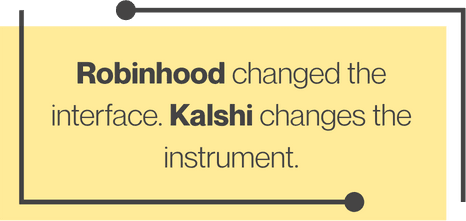
Why Robinhood changed user behavior (not markets)
Robinhood is a stock & crypto trading app that made trading feel simple:
- Tap-to-buy UI
- No commissions
- Feels like using your phone, not a finance terminal
It didn’t reinvent financial markets; it reinvented access. Trading suddenly felt:
- Instant
- intuitive
- mobile-first
- frictionless
You weren’t logging into a brokerage terminal anymore, you were tapping a screen.
Robinhood normalized a powerful behavior: participate in markets directly.
That behavioral shift is now showing up in sports outcomes.
Enter Kalshi.
Kalshi and Polymarket
Kalshi is a CFTC-regulated financial exchange where real-world events trade like commodities. You trade outcomes the same way you’d trade oil, corn, or interest rates.
Each contract is priced between $0 and $1, representing the market's implied probablity:
- $1 if the event happens
- $0 if it doesn't
Example:

If the Chiefs win → the contract settles at $1. If not → it settles at $0.
What makes this structurally different from a sportsbook is what happens between entry and settlement.
Participants can:
- buy positions
- sell early
- hedge exposure
- react to new information
This is not wager behavior.
It is market behavior.
Polymarket, now operating in the U.S. after roughly $2 billion in investment from Intercontinental Exchange (the parent company of the New York Stock Exchange), staged across three rounds since October 2025, has taken a similar structure mainstream. Its U.S. app launched in late 2025 focused entirely on sports contracts. Two major platforms, the same underlying logic: price the probability, trade the outcome.
And regulators are paying attention. The National Collegiate Athletic Association (NCAA) has already challenged whether certain college-sports contracts functionally resemble sports betting — highlighting just how thin the boundary has become.
Because once probability is priced…
…it can be traded.
The convergence is no longer theoretical
Over the past year, signals of structural convergence have accelerated:
- National Hockey League (NHL) licensed its marks to prediction platforms, the first major U.S. league to do so.
- Robinhood acquired LedgerX, a CFTC-licensed exchange and clearinghouse, giving it the infrastructure to directly list and clear prediction contracts without relying on third-party platforms.
- DraftKings acquired Railbird to expand exchange-style capabilities.
- Polymarket's $2 billion ICE deal positioned it as an institutional-grade prediction exchange, not just a crypto novelty.
- FanDuel, DraftKings, PrizePicks, and Underdog have all signed prediction market partnerships, signaling that even traditional operators see the writing on the wall.
These are not product experiments.
They are category signals.
Betting and trading are no longer cleanly separable.
They increasingly share:
- pricing mechanics
- probability models
- risk management behaviors
- real-time information flows
The question is no longer:
“Is this betting or trading?”
The real question is:
Who prices uncertainty better?
What actually changed (and what didn't)
Here is the mistake many observers make:
They assume platform innovation creates the edge.
Historically, that was sometimes true.
But as interfaces standardize, advantage migrates elsewhere.
When everyone can tap “buy,” the only durable separation becomes:
- signal quality
- modeling sophistication
- speed of interpretation
In other words:
The edge shifts from execution → intelligence.
This is the quiet transformation underneath the noise.
Where things stand in 2026
The pace has accelerated faster than most observers expected. A few developments worth understanding:
Sports is now the dominant use case for prediction markets, not politics. Kalshi derives the majority of its trading volume from sports contracts, and Polymarket's entire U.S. operation is sports-focused. The 2024 election drove the initial mainstream awareness, but sports is what's sustaining and growing the volume.
The regulatory battle is active, not theoretical. Traditional sportsbooks and casino operators want prediction markets regulated at the state level, the same framework they operate under. Kalshi argues it offers federally regulated "event contracts," not gambling. Massachusetts, Michigan, Nevada, New Jersey, and Ohio have all pushed back on prediction markets' move into sports betting, and two federal appeals courts have now ruled on the underlying question in opposite directions. In April 2026, the Third Circuit sided with Kalshi, ruling (on a preliminary basis) that federal law gives the CFTC exclusive jurisdiction over sports event contracts, which blocked New Jersey from enforcing its gambling law. In August 2026, the Ninth Circuit ruled the opposite way for Nevada, upholding the state's authority to regulate those same contracts as gambling. That split between two federal courts is the kind of conflict the Supreme Court typically has to resolve, and Kalshi has said it will seek further review. The outcome of this jurisdictional fight won't just set the pace of convergence, it will decide whether convergence happens the same way nationwide or fragments state by state.
Robinhood is becoming its own exchange. The LedgerX acquisition means Robinhood will no longer route contracts through Kalshi's infrastructure; it will list, clear, and settle its own prediction contracts. That's a structural shift from broker to exchange, and it significantly increases the retail surface area for this market.
Volume is now larger than during the 2024 election. Prediction markets have blown past that mark since. Combined monthly volume on Kalshi and Polymarket grew from under $5 billion in September 2025 to about $24 billion by April 2026, and Polymarket's 2026 World Cup champion market alone drew $3.7 billion in trading volume, on pace to become the platform's single biggest market ever, ahead of the roughly $4 billion wagered on the 2024 U.S. presidential election. The post-election "will this last?" question has been answered.
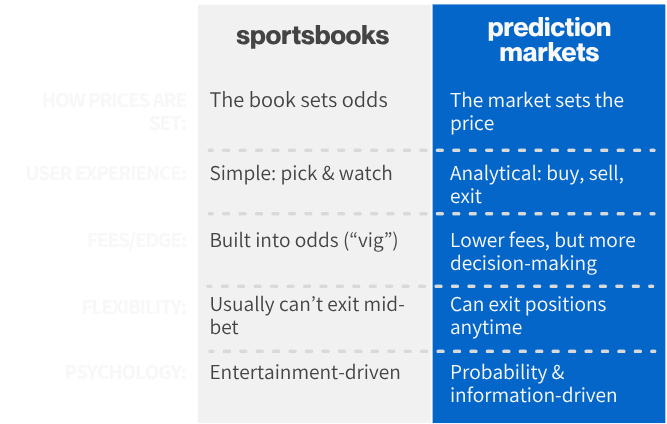
Sportsbooks vs. prediction markets: coexistence, not replacement
Prediction markets are not about to eliminate sportsbooks.
They serve different psychological and behavioral needs.
Most bettors still want a simple experience:
Pick a side.
Watch the game.
Feel the outcome.
Managing positions like a trader is a different mindset, one that will grow, but not universally.
The future is not replacement.
It is parallel evolution.
Entertainment-driven wagering will remain massive.
Market-style participation will expand alongside it.
Both can thrive.
But both reward sharper decision-making.
What this means for participants
As pricing becomes more explicit, one skill compounds in importance: understanding probability.
Because whether you are:
- betting a spread
- buying a contract
- exiting at halftime
…the core question is identical:
Is this price efficient?
Most people cannot answer that confidently.
Which is exactly why intelligence layers are emerging.
Why Moddy sits above the platform wars
Moddy does not try to be a sportsbook.
It is not an exchange.
It is not a picks service.
Moddy is the intelligence layer.
Whether you're betting a spread, buying a Kalshi contract, or evaluating a Polymarket position, the core question is identical: is this price efficient?
We help you:
- Interpret what odds actually imply
- Identify mispriced probability
- Track model performance over time
- Prove edge instead of guessing
If the future leans toward exchanges, Moddy already speaks probability.
If sportsbooks remain dominant, Moddy still sharpens decisions.
Platforms will evolve.
Interfaces will change.
The need for better signal will not.
That makes intelligence structurally durable.
What to watch next
Several forces will determine how quickly this convergence accelerates:
- Resolution of the federal vs. state jurisdictional fight over prediction market regulation
- Whether Robinhood's LedgerX exchange launches on schedule and at what scale
- How aggressively Polymarket expands its U.S. sports offering beyond its current launch slate
- Additional leagues entering the space
- Whether sportsbooks build exchange mechanics in-house or continue acquiring their way there
The tipping point will not be technology.
It will be familiarity.
Once users grow comfortable treating outcomes like assets, behavior follows quickly.
The deeper shift most people are missing
The industry is not just getting bigger.
It is getting smarter.
Participants are beginning to ask better questions:
Not
“Who should I bet on?”
But
“Is this probability priced correctly?”
That is the intellectual maturation of the market.
And as betting and trading converge, the advantage will increasingly belong to those who understand:
- probability
- value
- model performance
—not those chasing narratives or hot streaks.
The bottom line
The environment will keep evolving.
But one principle is becoming clearer:
Edge will belong to those who interpret uncertainty better than the market.
Moddy exists for that future.
A future where outcomes are priced , not guessed.
Where performance is tracked, not implied.
Where edge is demonstrated, not claimed.
Platforms may shift.
The signal is what endures.
Further reading
- CME Group: What is a Futures Contract? – Overview of how futures work in financial markets
- CFTC on Prediction Markets – U.S. regulator’s stance on prediction markets and event contracts
- Betfair Exchange Guide – How peer-to-peer betting exchanges work in practice
- What Are Prediction Markets and Why Are They Controversial? Sportico's coverage of all the major players, the regulatory fight, and the scale of the market
- Bloomberg: BofA Estimates $1.1 Trillion US Sports Event Betting Market - Bank of America estimates the potential market for U.S. sports-related event contracts at roughly $1.1 trillion in annual volume
- Federal Circuits Split on Kalshi-Nevada Ruling, SCOTUS Likely to Review (Sportico)
- Kalshi takes legal blow in court ruling confirming state powers over prediction markets (Coindesk)
- Federal Appeals Court: CFTC Jurisdiction Over Sports Event Contracts Likely Exclusive (Holland & Knight)
- Trading volume on prediction markets has soared in recent months (Pew Research)
- NYSE owner doubles down on Polymarket with fresh $600 million investment (Coindesk)
- Polymarket's 2026 World Cup Winner Market Exceeds $3.7B in Trading Volume (Deadspin)
Updated August 2026