.png)



TL;DR
- The Rundown and The Read are Moddy's AI analysis layer, built on top of Top Picks.
- The Read sits at the top of your Top Picks list: a one-line take on the whole slate, plus a full breakdown of where picks are clustering, contradicting each other, or quietly correlated.
- The Rundown is a home screen carousel of the 3 to 5 picks the analysis likes best right now, each one with the case for it, the model's track record, and a Risk line that names exactly what could make it wrong.
- It refreshes every hour up to game time, and it'll flat out tell you when it's got nothing. No manufactured picks just to fill space.
- It's AI-generated analysis, not betting advice. The bet's still yours.
Here's a problem we think about a lot.
Say you've got hundreds of models running across every sport and every kind of outcome. Moneylines, spreads, batter hits, strikeouts, runs, all of it. On a normal night that's thousands of individual predictions. Now what? You still have to answer the only question that actually matters: what do I bet?
That gap, between "here is a mountain of really good analysis" and "here is the bet I'm making," is where most people get stuck. We got stuck there too.
We started with Top Picks
Our first swing at this was Top Picks. It looks at every pick being made across every Moddy model, not just the ones you follow, and not just the models that happen to be hot, and scores each one on two things: how confident the model is in that specific pick, and how that model has actually performed on similar picks recently. A high-confidence pick from a proven model rises to the top, but a very strong pick from a newer model can still outrank a weaker pick from an established one. We also diversify the list, so you're not staring at a wall of picks from a single model or piled onto a single game. What comes out is the top 50.
That's a great filter. But 50 picks across a full slate is still a lot to stare at, and a ranked list doesn't tell you how those picks relate to each other. You're still doing the hard part yourself.
Now think about what "doing the hard part" actually means
Picture working that list of 50 properly, by hand.
For every single pick, you'd track how the line has moved and how jumpy it's been, whether the expected value is climbing or sliding, and how the pick's edge holds up against its own history.
Then you'd group the picks by game and hunt for the things a single-pick view hides. Two picks in the same game that flat-out contradict each other. Or the subtler one: a handful of picks that look independent but are really the same bet wearing different jerseys, because they all cash or all die on the same outcome. Diversifying the list keeps you from drowning in one matchup, but it doesn't tell you when the picks that survived are quietly correlated.
Then you'd layer in the outside world. Injuries, weather, news, a starter who's been quietly better since coming off the IL, a player's own history in spots like this one.
And then, because lines never sit still, you'd do all of it again an hour later. And an hour after that.
No human is doing that across a full slate. We definitely can't. So we built something that does.
Meet The Rundown and The Read
The Rundown and The Read are an analysis layer that sits on top of Top Picks and does all of that work for you, every hour, right up until game time. Every time the picks update with new information, we rebuild the Top Picks list and then actually read it.
Two things come out the other side.
The Read is the big-picture take on the whole slate. It lives at the top of the Top Picks list on the Picks page: a one-line summary of where the board stands, with a Full breakdown → button that opens the whole thing. Inside you get the full read on where the picks are clustering and which way the trends lean, followed by a Worth Knowing list: the contradictions, the correlated bets, the numbers that look too good because they're built on a thin sample.
The Rundown is the punchline. It's a swipeable carousel on your home screen holding the 3 to 5 picks the analysis likes best out of the thousands, ranked. Each card shows you the pick itself, player or team, the matchup, the market, the price, and a 🔥 if the model thinks it's found a significant edge, then explains in plain language why it's there, including the receipts: how the model behind it has actually performed on picks like this one. And then, on every single card, it argues the other side.
Tap a card and you get the full picture: the complete write-up, the expanded version of that risk, and the pick's own charts, how the line has moved, how the expected value has trended, where the edge is now. At the bottom is the model that made the pick, one tap from its full performance record, so "trust me" is never the argument. You can also save any pick straight from the card without leaving home.
Model and pick names inside the analysis text are tappable too. When The Read mentions a specific pick or a specific model, you can go straight there.
Both surfaces stamp the time of the last analysis run, so you always know how fresh the read is. And if it's not for you, you can turn the whole thing off under Preferences → AI Analysis.
The Risk line is the part we're proudest of
Every Rundown pick carries a Risk line. Not a legal disclaimer, not a generic "bet responsibly," a specific, named reason this particular pick might not work, written about this particular pick.
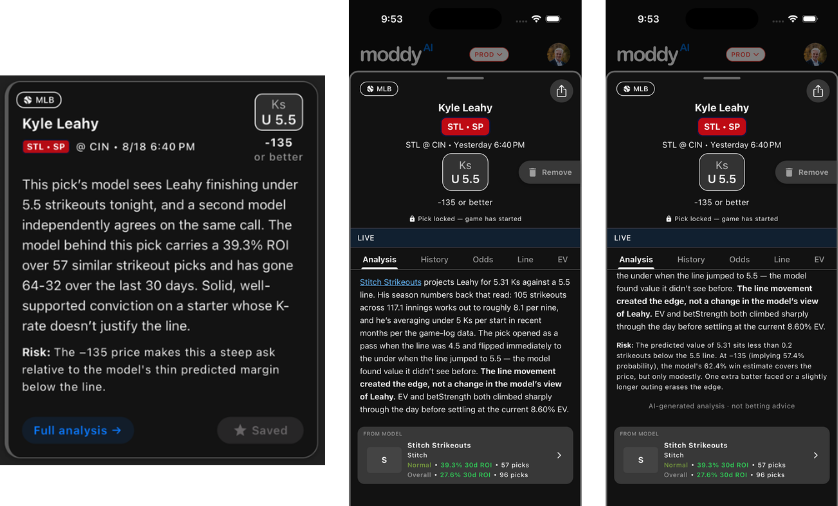
Here's a real one. Kyle Leahy, under 5.5 strikeouts, −135. The card's case for it:
This pick's model sees Leahy finishing under 5.5 strikeouts tonight, and a second model independently agrees on the same call. The model behind this pick carries a 39.3% ROI over 57 similar strikeout picks and has gone 64-32 over the last 30 days. Solid, well-supported conviction on a starter whose K-rate doesn't justify the line.
This pick's model sees Leahy finishing under 5.5 strikeouts tonight, and a second model independently agrees on the same call. The model behind this pick carries a 39.3% ROI over 57 similar strikeout picks and has gone 64-32 over the last 30 days. Solid, well-supported conviction on a starter whose K-rate doesn't justify the line.
That's a strong case. Two models agreeing, a 39.3% ROI over a real sample of similar picks, a recent record to back it. Plenty of products would stop right there and let you feel great about it.
Ours doesn't. Directly underneath, on the same card:
Risk: The −135 price makes this a steep ask relative to the model's thin predicted margin below the line.
Tap in and the risk gets sharper, with the actual numbers:
Risk: The predicted value of 5.31 sits less than 0.2 strikeouts below the 5.5 line. At −135 (implying 57.4% probability), the model's 62.4% win estimate covers the price, but only modestly. One extra batter faced or a slightly longer outing erases the edge.
Read that again, because it's doing something unusual. It just told you the margin on its own best idea is 0.19 strikeouts. It told you the edge over the market's own implied probability is five percentage points, and called that modest. It told you exactly what would break it: one more batter, one longer outing.
It's the same lesson our own NBA models have taught us the hard way: 78% Win Rate, 1.2% ROI: Why Even Great Models Struggle on NBA Moneyline. A great-looking number and a real edge are not the same thing, and this is what it looks like when an analysis engine actually admits the difference instead of burying it.
That is the whole point. We're not saying "bet these picks." We're handing you the case and the counter-case, side by side, at the same level of detail, and letting you decide. A pick with a thin margin and a great model behind it is a completely different bet from a pick with a fat margin, and no ranked list on earth will tell you which one you're looking at. The Risk line does.
It's also the honest test of whether an analysis engine is any good. Anything can generate a confident paragraph. Naming the specific thing that would make you wrong, with numbers, is harder, and it's the part you actually can't get anywhere else.
It's built to tell you the truth, not to hype you up
This part matters to us, so we want to say it plainly.
If a jaw-dropping ROI is really just a small sample, the analysis says so instead of quoting the number and moving on. If two picks in the same game can't both cash, it points right at them. And as above, every pick's specific risk gets named on the card, right next to the case for it.
It also tells you when it has nothing. If there's nothing on the board, The Rundown says so and looks ahead to upcoming games. And if it reads the full board and genuinely doesn't love anything, it says that too, "Moddy read the full board and nothing stands out right now," instead of manufacturing three picks to fill the space. A feature that can't say "nothing today" isn't giving you analysis, it's giving you content.
To be clear about what this is: it's AI-generated analysis, not betting advice, and every surface says so. It's here to explain the "why" behind the strongest picks so you can make your own call. The picks it likes best are the picks it likes best; the bet is still yours.
Most betting content is engineered to make you feel confident. This is engineered to make you smarter. Those are very different goals, and we know which one we'd rather be known for.
Here's what it looks like
.png)
It's live
The Rundown and The Read are in the Moddy app now: The Rundown on your home screen, The Read at the top of Top Picks on the Picks page. If you've ever stared at a wall of great predictions and still had no idea which one to put your money on, this is the feature we built for you.
The Rundown's already read tonight's board. Open the Moddy app and see what it found.