.png)



I'm not a data scientist. I lead marketing at Moddy, which means my job is to explain what we've built to people who haven't built it.
Lately, that's gotten a lot more interesting. Because suddenly, everyone is building.
If you spend any time on X, you've seen the posts. Someone ships an AI-powered sports prediction platform in 24 hours, posts the screenshot, collects the likes. It looks impressive. And some of it is. But there's something consistently missing — and it took a viral experiment involving Dwayne Johnson to help me put my finger on it.
The copy of a copy
Last year, someone on Reddit asked ChatGPT to recreate a photo of Dwayne Johnson (The Rock) — same image, no changes — 101 times in a row, each time feeding the new output back in as the starting point. The first few iterations looked pretty good. By iteration 50, things were getting weird. By 101, it was unrecognizable. Abstract. Picasso on a bad day.
It went viral because it's funny. But it's also quietly one of the best illustrations of a problem that goes way beyond image generation.
Enter vibe coding
"Vibe coding" is what happens when you use AI to build software by describing what you want in plain language — prompting your way through an entire product without really understanding the code underneath. You're not engineering, you're directing. The AI writes it, you iterate, and somewhere along the way you have something that looks like a finished product.
And hey, I get it. It's genuinely exciting. The democratization of building is real. Tools that used to require a team of engineers can now be scaffolded by one person with good prompts and a weekend.
But here's the thing nobody talks about in those posts: there's a difference between a model that looks like it's finding edge and one that actually is.
I actually asked Claude about this
Here's where it gets a little meta.
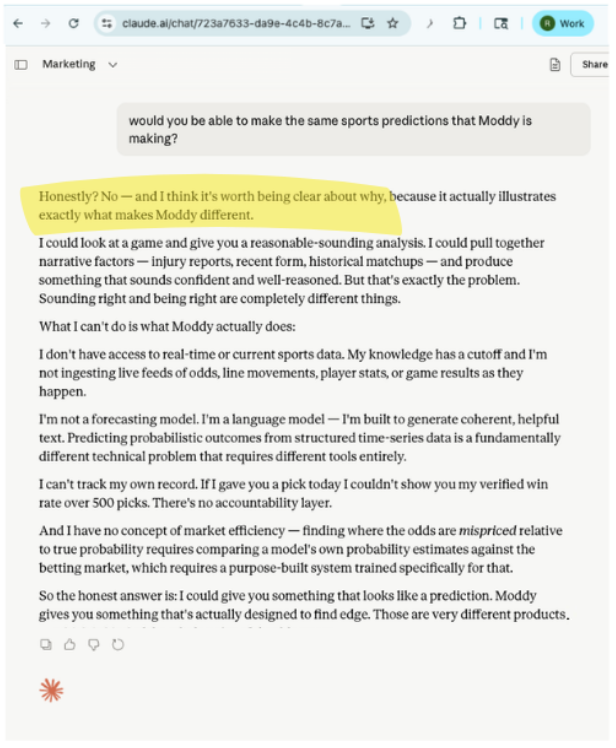
I decided to go straight to the source and ask Claude directly: would you be able to make the same sports predictions that Moddy is making?
The answer was refreshingly honest:
"I could give you something that looks like a prediction. Moddy gives you something that's actually designed to find edge. Those are very different products."
That's not false modesty. It's an accurate description of two fundamentally different types of AI doing two fundamentally different jobs — and exactly the distinction that gets lost in the vibe coding conversation.
The signal degradation problem
Back to The Rock.
What made that experiment so visually striking is that the degradation is invisible at first. Iteration 2 looks almost identical to iteration 1. Iteration 10 looks pretty close. It's only when you zoom out and see the full arc that you realize how far it's drifted from the original signal.
Vibe coded prediction models have the same problem; it just plays out over picks instead of pixels.
Every layer of abstraction you add compounds the noise. A general AI that wasn't built for time series forecasting. A sports data API that gives you numbers without context. A model architecture that was prompted into existence rather than engineered. A validation process that checks whether it seems right rather than whether it actually beats the market.
Each step looks fine in isolation. But the signal underneath has been degrading the whole time.
Researchers call the broader version of this problem model collapse — what happens when AI systems are trained on AI-generated outputs rather than real-world data. The distributions get narrower. The diversity drops. The model becomes more confident about less. It's an ouroboros: the output feeds the input, and each generation loses a little more fidelity to reality.
You don't need to understand the technical mechanics to recognize the pattern. You've already seen it in 101 iterations of The Rock.
What actually makes a prediction model work
Real sports prediction isn't a text generation problem. It's a time series forecasting problem. And those require completely different tools.
Language models like ChatGPT are trained to predict the next word in a sentence. They're extraordinary at that. But they have no concept of causality, no understanding of how a backup tight end's snap count quietly doubled last week, no ability to weigh matchup dynamics against current line movement. They'll give you a confident-sounding answer. Confidence and accuracy are not the same thing.
We went deeper on the technical side in a previous post — it's worth reading if you want to see exactly where general-purpose AI hits its limits on this kind of problem.
The tools that actually work — Random Forest, XGBoost, ensemble models — don't try to sound smart. They find repeatable patterns in structured data and turn them into probabilities. They're the same tools hedge funds use to predict markets. The sports betting industry has been investing in this kind of modeling for over 50 years because getting it wrong costs real money.
And even then, even with the right tools, the quality of the inputs matters enormously. Garbage in, garbage out. A model is only as good as the data it was trained on, the variables it was built to track, and the validation process used to separate real signal from noise.
Why this matters for bettors
If you're a bettor looking at the landscape right now, the explosion of AI-powered picks tools is equal parts exciting and dangerous.
Exciting because the technology is real and the potential is real. Data-driven modeling genuinely does produce better outcomes than gut feel or following a guy on X who never shows his losses.
Dangerous because most of what's being built right now — quickly, cheaply, on general AI infrastructure — hasn't been validated at the level that actually matters. It looks like signal. It might even produce a winning stretch. But a winning stretch and a model that consistently finds edge over thousands of picks are very different things.
The question to ask of any prediction tool isn't "does it look sophisticated?" It's "can I see its full track record, including the bad runs?"
What real predictive AI looks like
Moddy wasn't built in a weekend. Our co-founder Trey has been building predictive models for sports for more than eight years, and that work is the foundation of what we run today: ensemble modeling, multiple models working together with different strengths, cross-checking each other's outputs. Every pick is publicly tracked. Every model's full record is visible: wins, losses, ROI, edge. Bad runs aren't hidden. There's no cherry-picking.
That's not a knock on everyone experimenting with vibe-coded prediction tools. Experimentation is how the field moves forward. But there's a reason purpose-built systems exist, and it's the same reason you'd rather have a weather forecast from a meteorologist using decades of climate modeling than from someone who just asked an AI what it thinks tomorrow will look like.
The signal matters. And signal takes time to build.
I've spent enough time inside Moddy to understand what eight-plus years of focused work looks like versus what a weekend of prompting produces. You don't have to be an engineer to tell the difference. You just have to ask the right question: show me the full track record. The rest takes care of itself.