

Every betting product wants an edge in it. A model’s take next to every slip. A board that re-ranks itself as lines move. A daily write-up that actually says something. Almost none of them have a data science team to build it.
Moddy for Business is that team. It puts sports betting predictions in your product: ours, through Moddy Signals, or your own, built without code in Moddy Labs.
And one thing up front: these are models, not guarantees. Every model is calibrated and graded on live results, and nothing Moddy writes says “lock.”
TL;DR
- What it is: Moddy’s prediction engine, 30M predictions and counting across NFL, NBA, and MLB, delivered into your app, site, or newsletter.
- Moddy Signals: our models, boards, and written briefings, configured for your audience.
- Moddy Labs: your own models, built without code by anyone on your team.
- How it starts: a scoping call, then a paid 30-day pilot. At the end, you decide: move to a one-year agreement, or opt out.
- What we promise: the work of a data science team. Not betting results.
Why most betting products never get here
Here’s what we hear from almost everyone building a betting product: they want the edge, and they can’t staff it.
The ones that can often have it worse. They pay for data scientists and the infrastructure under them, and most of that budget goes to keeping the machine running: stats feeds, odds matching, retraining, monitoring. The ideas that would move the product wait in line behind the plumbing.
That’s not a knock. A real modeling operation is a lot:
- Stats pipelines for every sport
- Market definitions and odds ingestion
- Training and calibration
- Live predictions on every game
- Grading
- Someone to explain the output in a way a bettor will actually read
It’s a team, and most betting companies will never staff it. So we’re offering ours.
We built the engine for ourselves first
If you’ve used Moddy, you know the pieces: models built without code, Top Picks ranking every pick across every model, and The Read and The Rundown writing it all up with a named risk on every pick. That’s the engine Moddy for Business runs on, and it’s been running in production, with 30M predictions and counting.
Here’s what it does, in betting terms:
- Models. Each model targets one market, from moneylines and totals to player props, across NFL, NBA, and MLB: 49 markets in all. Under the hood, each is several models working from the same player and game stats. Some call the side, and some project the number.
- Predictions. On every run, every model re-predicts every upcoming game. You get a calibrated probability (more on that in a moment), a side, and a strength rating, all measured against our consensus line and price. A prediction becomes a bet only when its expected value, the average amount a bet should win or lose at its price, clears that model’s threshold. Otherwise it’s a no-bet, and we tell you that too.
- Boards. The ranked picks from a group of models you choose. Boards look past today, re-rank on every run, and drop dead picks when games are postponed or players are scratched. When several models independently back the same side, that agreement counts.
- Briefings. The Read, The Rundown, and The Parlay, written from the top of every board.
For the Moddy bettor app, we pointed all of that at our own users. Moddy for Business points it at yours.
A quick word on “calibrated.” It means the percentages mean what they say. If a model says 70% across a hundred games, about seventy of them should win. A model that’s confident but wrong isn’t useful, and calibration is how we check.
Two ways to work with Moddy
Moddy Signals: our models, in your product
Moddy Signals isn’t one feed for everyone. We build a mix of models and boards around your audience, down to how picks are ranked, and deliver it into whatever you’ve built: an app, a site, a newsletter. It comes in three parts.
Predictions are the model output as data. Each one includes:
- Calibrated probability
- The model’s projection, for stat markets
- Side and price
- Strength
- Where the pick opened and how it moved
With that, you can put a model’s take next to any bet a user logs, badge their picks as agree or disagree, or alert them when a game they follow flips from no-bet to bet.
Briefed Boards are those predictions, ranked and written up. You tell us who the board is for, and we configure the models, markets, and ranking. Every run re-ranks the board and rewrites The Read, The Rundown, and The Parlay on top of it. Briefings follow your brand’s voice and arrive as structured content your editors can review before anything ships.
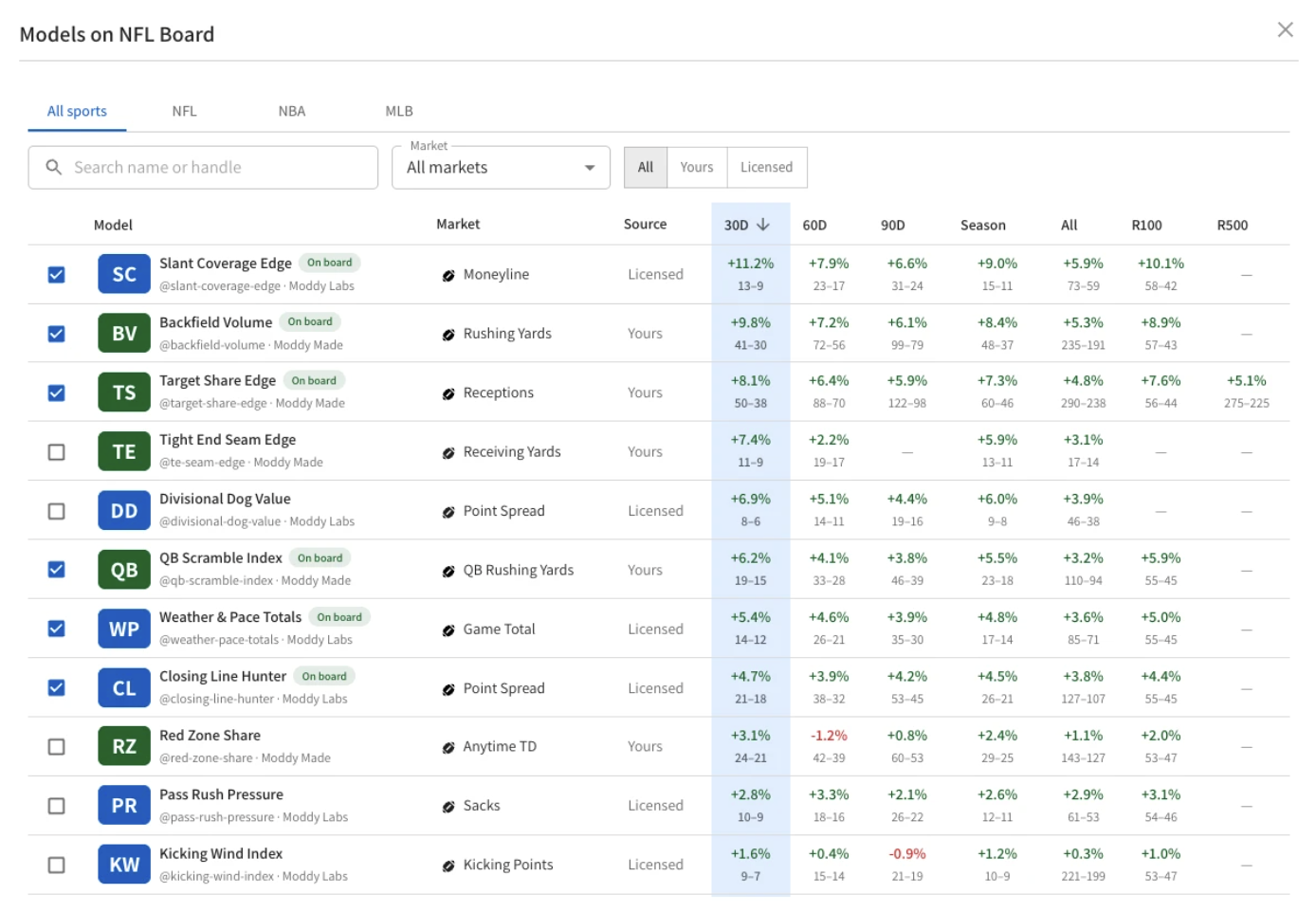
Model Analytics grades every model behind your content on live results:
- Record and return
- Closing-line value: whether the model got a better price than the market’s final one
- Skill against the market: whether it beats the odds, not just wins games
- Calibration
Use it to pick which models to feature, or show it to your users. There are no backtests here. Backtests are a build tool, not proof.
Moddy Labs: your data science team
A data science team turns ideas into features, trains and tests models, calibrates them, and keeps them running. Moddy Labs does all of that, for anyone on your team, without code. You bring the betting ideas.
- Describe an angle in plain English, and the Lab Partner, our built-in AI assistant, turns it into model inputs and suggests stats you hadn’t considered.
- Every model is trained, tested against the betting market, and calibrated before it can be published.
- Once a model is live, its picks feed your own boards and briefings, and Model Analytics grades it the same way we grade ours.
One account can hold several private Labs: separate desks for a company, or a Lab for every creator on a marketplace. Your models and their picks are yours to use and never show up in Moddy’s own products. If you’d rather start producing before your team has built anything, we can build models to your spec inside your Lab.
Already have data scientists? Labs makes them faster. The data, training, calibration, live predictions, and grading are already built, so they spend their time on ideas instead of pipelines.
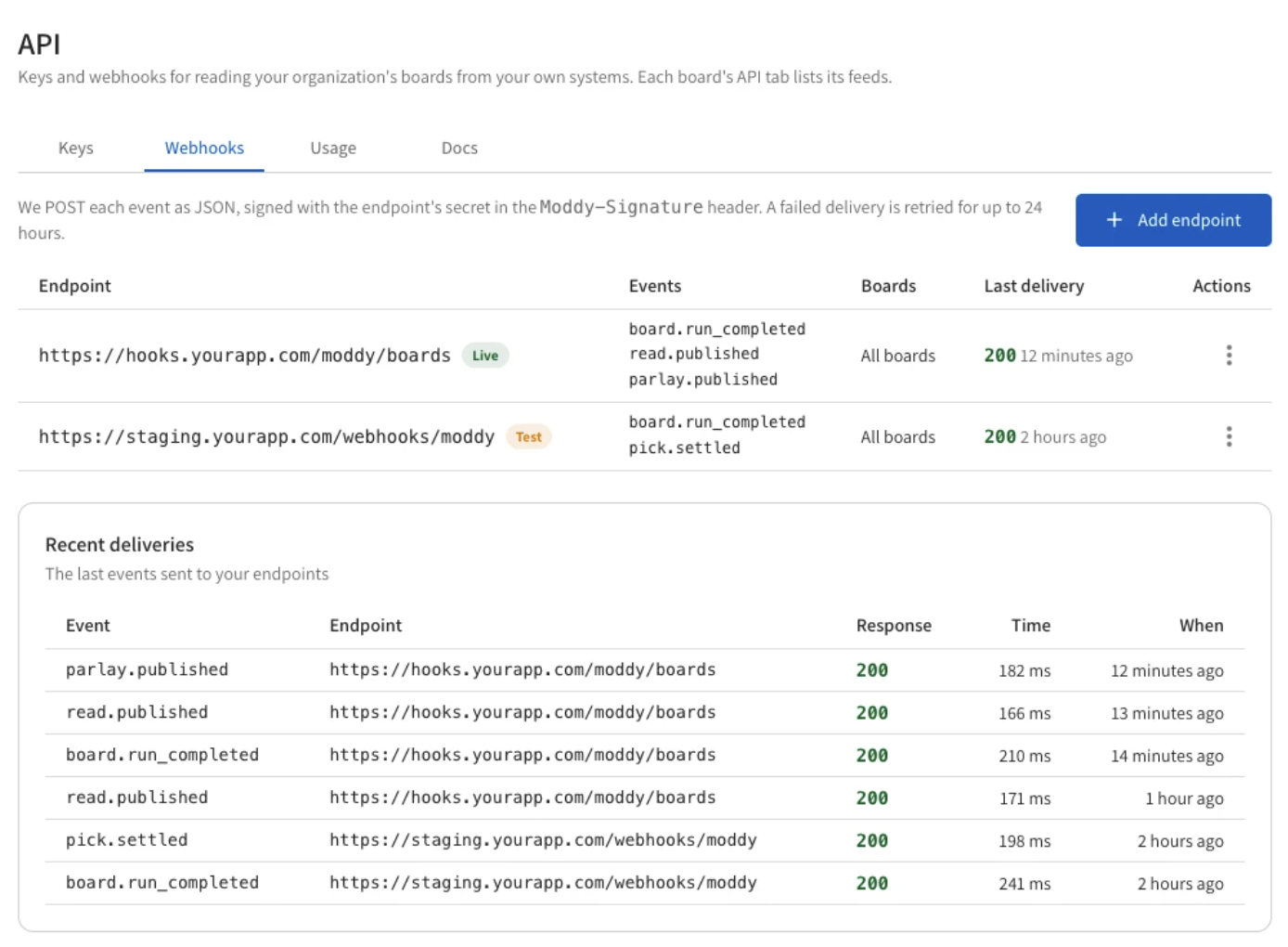
Many partners will use both: Labs for the models their team builds, Signals for ours, side by side on the same board if they want. Everything arrives as JSON: pull it from our REST API, or have us push it to your webhooks as each board runs and each briefing publishes. You build and run the experience.
Here’s what your users would read
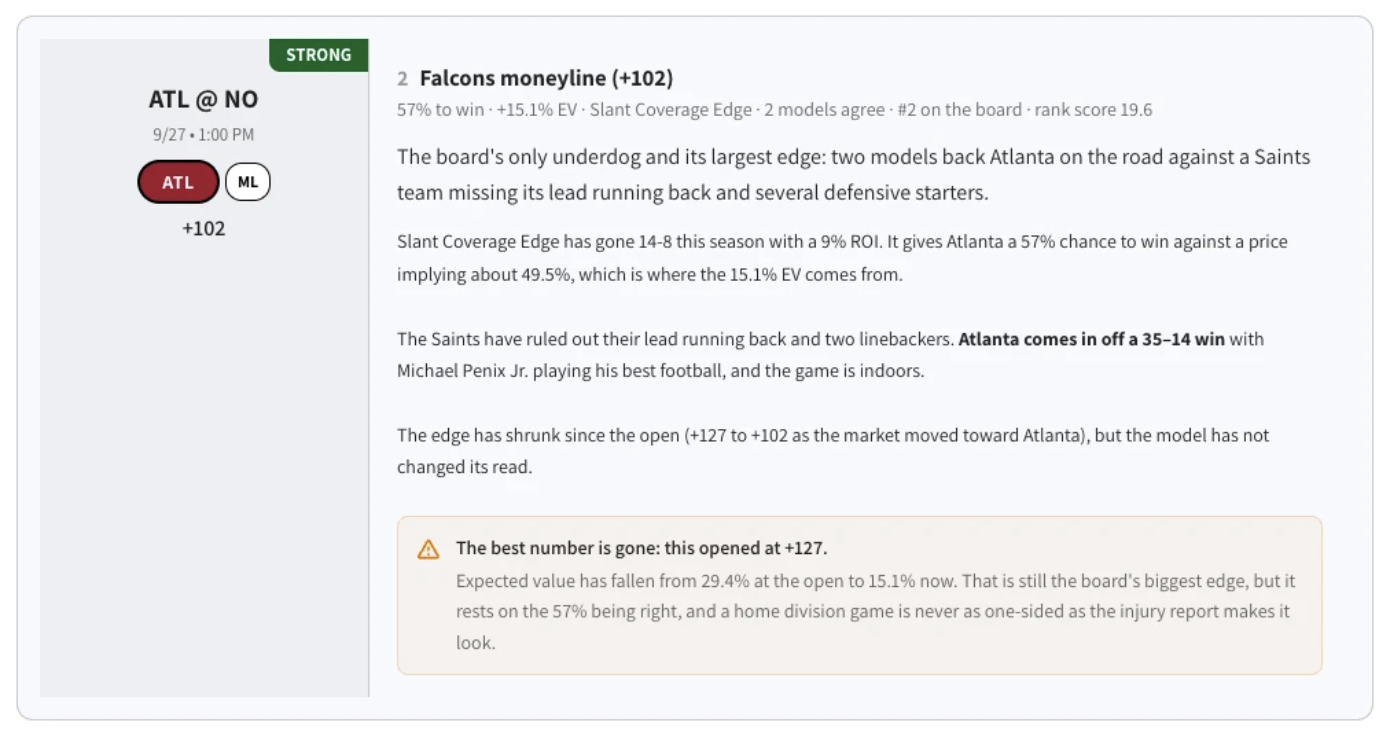
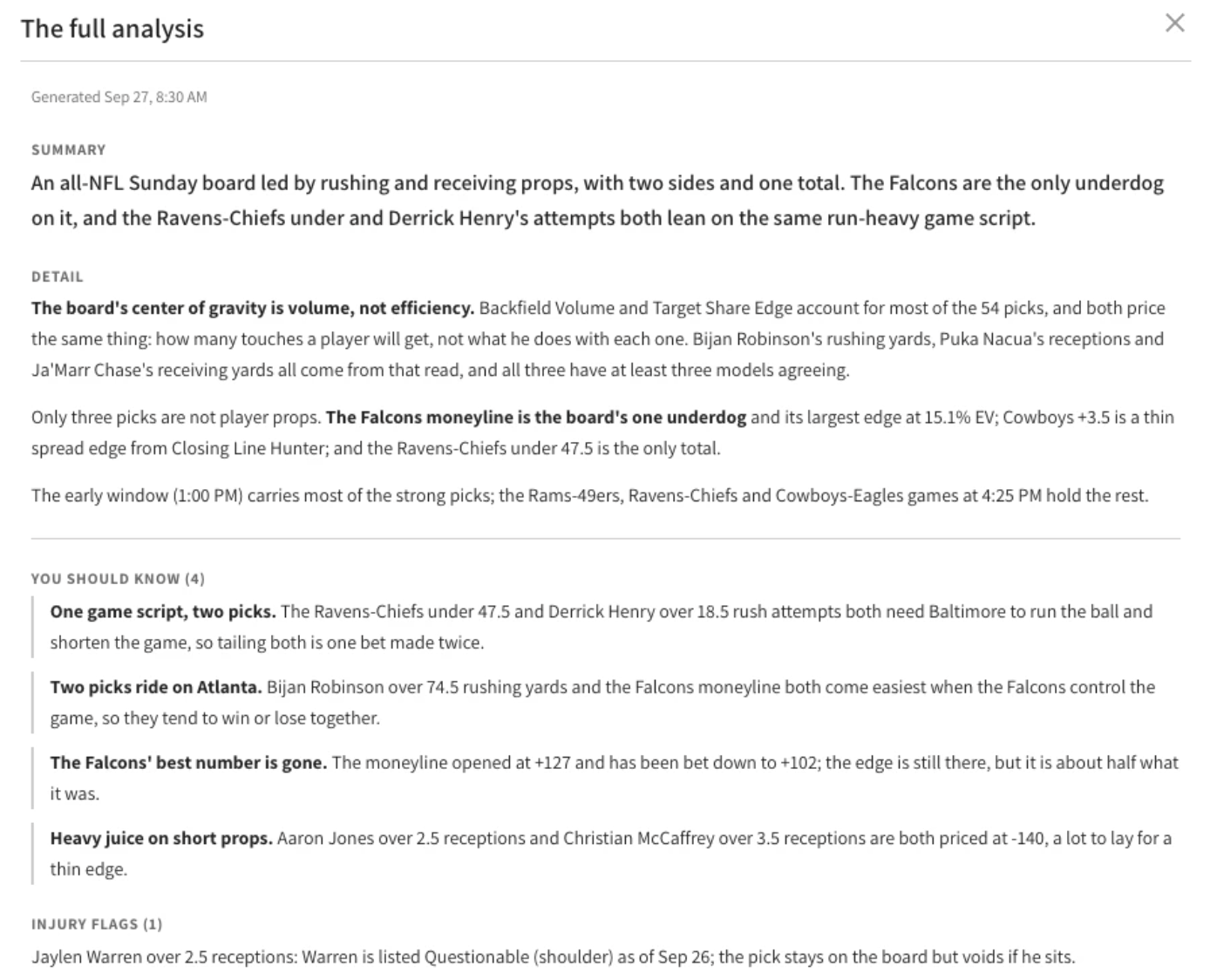
A Rundown pick from a live board, lightly edited. Falcons moneyline, +102.
The case. Slant Coverage Edge has gone 14-8 this season with a 9% ROI. It gives Atlanta a 57% chance to win against a price implying about 49.5%, which is where the 15.1% EV comes from. The Saints have ruled out their lead running back and two linebackers, and Atlanta comes in off a 35–14 win. The price has moved from +127 at open to +102 as the market came toward Atlanta, but the model hasn't changed its read.
A strong case: a named model, its record this season, a big gap to the price, and the matchup detail that matters. Then, on the same pick:
The risk: the best number is gone. This opened at +127, and expected value has fallen from 29.4% to 15.1%. That's still the board's biggest edge, but it rests on the 57% being right, and a home division game is never as one-sided as the injury report makes it look.
That's the part we'd point any partner to first. It tells your users the line has already moved 25 cents against them, and that the whole bet rests on one number being right. Every Rundown pick and every Parlay leg names its own risk like that, written about that pick, not pasted in from a disclaimer.
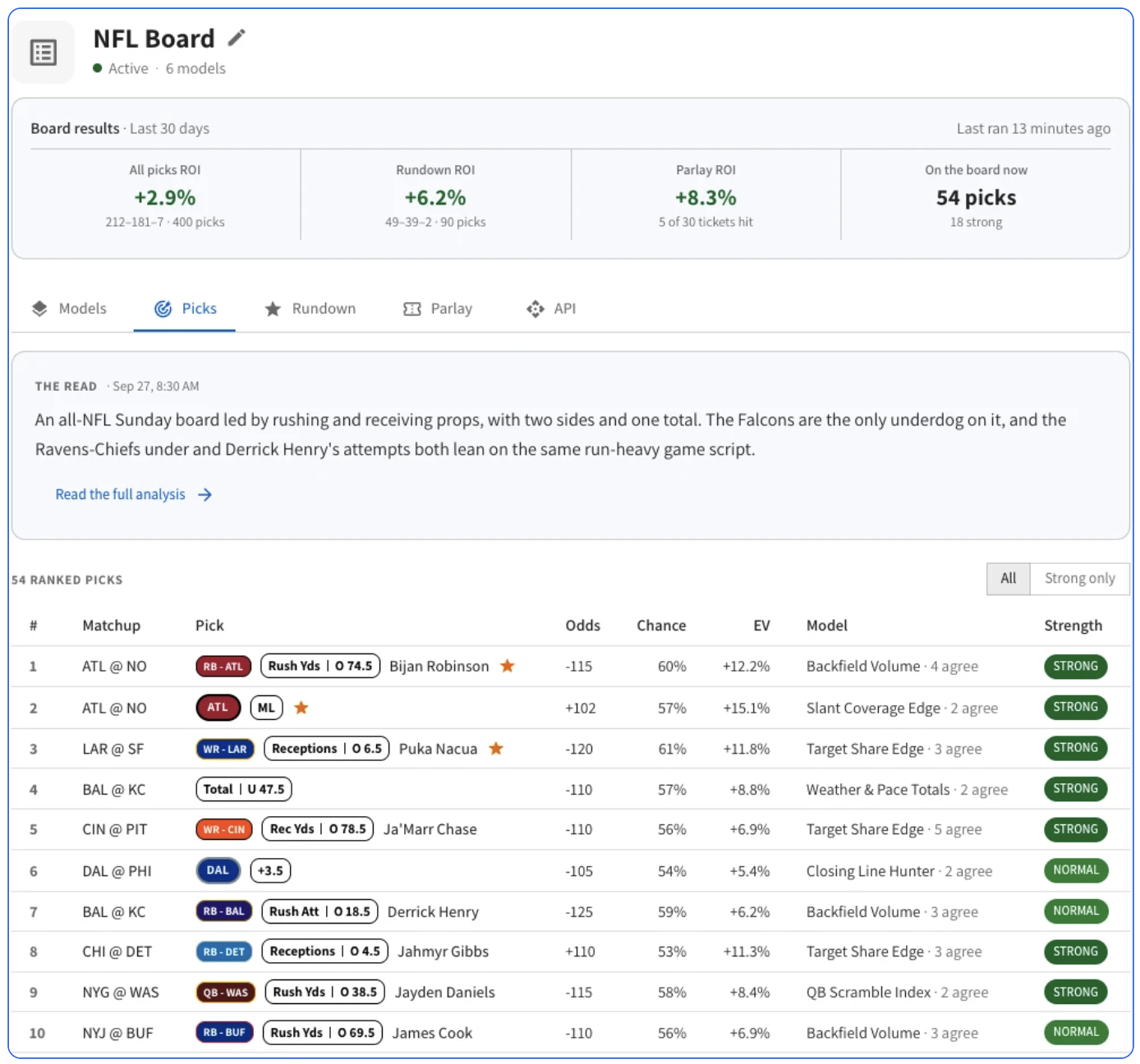
The Read does the same at the board level. Its You Should Know flags call out two picks that are really one bet made twice, several picks riding on one team, edges that have faded since the open, and heavy prices on thin edges. On this board, the Ravens-Chiefs under and Derrick Henry's rush attempts both need Baltimore to run the ball, so tailing both doubles one bet.
Models, not guarantees
We want to be plain about this, because it shapes everything we ship.
Moddy’s outputs are what a model sees, not what will happen. A 60% pick loses four times in ten, and the best models go through cold stretches. One of our NBA models won 78% of its first 49 picks and returned just 1.2%, so we published the full breakdown of why a high win rate isn’t the same as profit instead of just the headline number. They’re tools to use alongside your own data and judgment. That’s why every model is calibrated, every result is graded on live results in Model Analytics, and nothing Moddy writes says “lock” or “guaranteed” or tells anyone to bet.
It’s also why our briefings are allowed to say nothing. If a big ROI is really a small sample, the briefing says so. If the board has nothing worth highlighting, it says that instead of manufacturing picks to fill the slot. (Yes, we built a product that’s allowed to shrug. It’s the most trustworthy thing in the building.)
The “data science team” claim is about the work, not the results. Labs does what a data science team does. Whether a given model finds an edge is something Model Analytics will tell you, honestly, over time.
How we start
Every engagement starts with a scoping call and a paid 30-day pilot.
In scoping, we agree on your use case, sports, markets, boards, delivery, and voice, and we set the measures the pilot will be judged on. Those measures are about fit: delivery reliability, integration, content quality, and your own engagement numbers. Not betting results. Thirty days is nowhere near enough to read betting performance, and we won’t pretend otherwise.
In the pilot, the work depends on what you chose:
- Signals: we set up your boards and predictions and deliver them to a test group of your users.
- Labs: we set up your Labs, train your team, and follow up once it has built its first models.
Either way, the pilot is where you validate the output. Run the predictions, boards, and briefings through your own review and compliance checks, so you’re confident in what you’re giving your users before it reaches all of them.
At the end, you decide. If it’s working, we move to a one-year agreement. If it isn’t, you opt out.
Let’s talk
Moddy for Business is open now for bet trackers and betting tools, pick’em and fantasy platforms, prediction market apps, handicapper and creator platforms, and betting media.
If you’ve wanted predictions in your product and never had the team to build them, this is the team. Tell us about your product, your audience, and what you’d want Moddy to do, and we’ll come back with a proposed pilot.